

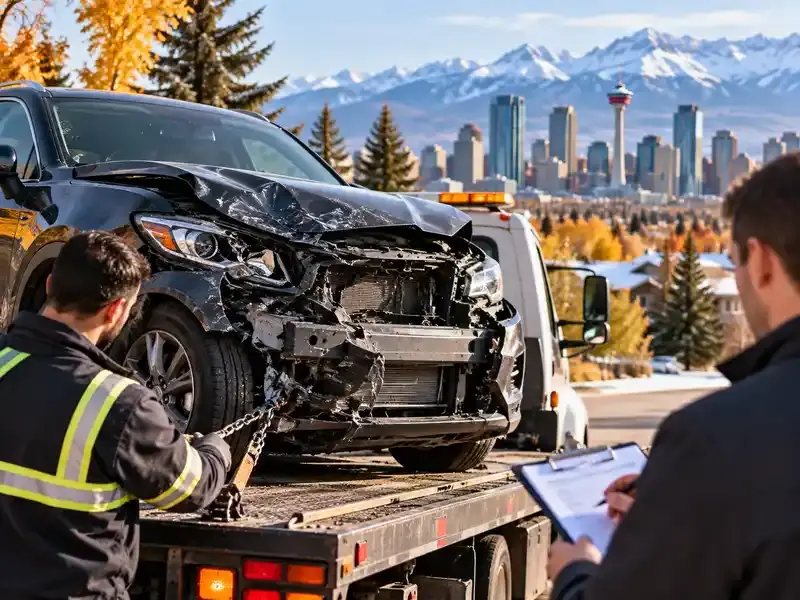
What is an insurance write-off vehicle Alberta drivers hear about it after a crash. It is a car the insurer has decided costs too much to repair. The insurer pays a settlement instead of paying for repairs. What happens next depends on the settlement terms, the status Alberta records against the vehicle, and whether you want to surrender it, keep it or sell it. This guide walks you through each path.
General information only. This is not legal or insurance advice. Always confirm details with your insurer and the official Alberta pages listed at the end. Last reviewed: October 17, 2026.
Quick Answer: What You Need to Know
- A write-off (total loss) is the insurer’s decision to pay a settlement instead of repairing. Alberta’s recorded vehicle status is related, but it is a separate classification.
- A salvage vehicle must pass an Alberta salvage vehicle inspection before it can be registered again.
- A non-repairable vehicle cannot be registered again. It is limited to scrap or parts.
- If you want to keep or sell the vehicle, confirm the settlement terms and who has the right to transfer ownership first.
- Your main paths are: accept the settlement and surrender the vehicle, ask about keeping it, dispute the valuation, or explore selling it.
Insurance Write-Off Vehicle Alberta: What Does a Total Loss Mean?
A write-off, also called a total loss, means the insurer decided repairs cost too much compared with the vehicle’s value, so it pays a cash settlement instead. The insurer compares three numbers: the vehicle’s actual cash value (ACV) before the loss, the estimated repair cost, and what the damaged vehicle could sell for as salvage. If repairs look uneconomical, the insurer declares a total loss and settles the claim in cash. AIRB’s key terms glossary defines both terms.
That decision can surprise you. A car that still looks decent after a collision on the Anthony Henday or a hailstorm in Calgary may be written off. Modern vehicles carry costly sensors, airbags, and structural parts. Repair bills climb fast.
AIRB’s guide to auto claims says an appraiser weighs the vehicle’s ACV immediately before the loss, its estimated salvage value, and the total repair cost. It does not state a repair cost percentage, so do not assume one applies to your claim. The glossary adds that a vehicle can be a total loss even when repairs cost less than its ACV, for reasons such as safety or repair quality. Your policy wording sets the terms of your claim.
One more point matters here. The insurer’s total loss decision is separate from the status on a vehicle’s Alberta record. Alberta requires a vehicle written off by an insurance company to be reported and to pass a salvage vehicle inspection before it is registered again, and a non-repairable vehicle cannot be registered again. A Vehicle Information Report shows the recorded status.
How Does Actual Cash Value Car Insurance Alberta Work?
Actual cash value means the market value of your vehicle immediately before the loss. It is not what you paid. It is not the cost of a new replacement either. Insurers look at:
- Year, make, model and trim
- Mileage, overall condition, and tire and mechanical condition before the accident
- Factory options and documented upgrades
- Comparable vehicles sold or listed in your area, where the insurer uses them
- Your policy terms and deductible
Here is a simple example. It is an illustration only, not a formula that fits every claim.
| Item | Example amount |
| Vehicle value before the loss (ACV) | $12,000 |
| Policy deductible | $500 |
| Example settlement if the insurer keeps the vehicle | $11,500 |
Many owners confuse two figures. One is the insurer’s ACV. The other is the asking price of a similar vehicle in a current listing. These can differ, and neither must always equal the other. Ask for the valuation report so you can see exactly how the insurer reached its number.
Insurance Write-Off Vehicle Alberta Rules: Salvage, Rebuilt and Non-Repairable Status
Alberta records a written-off vehicle as salvage or non-repairable, and a salvage vehicle becomes rebuilt after it passes inspection. Those classifications follow the vehicle record and may affect its future use and resale. Alberta Transportation and Economic Corridors is the lead ministry for salvage vehicle inspections, and the Alberta.ca salvage vehicle inspections page explains the process.
Salvage vs. Non-Repairable: How Alberta Classifies Your Total Loss
In short: salvage can be repaired and inspected; rebuilt means a salvage vehicle passed inspection; and non-repairable cannot be registered again.
| Status | What it means | What you can do |
| Salvage | Declared salvage by an insurer; it must be repaired and inspected before it can be registered | Repair it, then pass a salvage vehicle inspection to register it again |
| Rebuilt | A salvage vehicle that passed the required inspection | Register and drive it, subject to Alberta’s rules |
| Non-repairable | Designated non-repairable; it cannot be registered again | Sell or dispose of it for scrap or parts only |
Rebuilt status stays with the vehicle for the rest of its useful life, according to Alberta.ca. Buyers can see it on a Vehicle Information Report, and it may affect resale. Plan for that if you want to repair and later sell.
How Can You Check Alberta Transportation Write-Off Status?
You check a vehicle’s write-off status by requesting an Alberta Vehicle Information Report online or through a registry agent in Edmonton or elsewhere in the province. You need the VIN, and online orders require an Alberta.ca Account. Registry agents are the licensed offices where Albertans handle licence plates and registrations. The report shows the vehicle’s status, such as active, rebuilt or salvage, plus the odometer reading if one was provided, registration dates, and the number of liens registered in Alberta.
Before any repair, purchase or sale, check the VIN against the report. Also know its limits. An Alberta report does not necessarily show the full history from another province or country. The report shows only the number of registered liens. For details, you can buy a search of the Personal Property Registry (PPR) from a registry agent.
Can I Legally Drive a Written-Off Car in Alberta?
Not if Alberta records it as salvage or non-repairable, so the answer depends on the status. An ordinary registered vehicle that was not branded follows normal rules. A salvage vehicle cannot be registered until it has been repaired and has passed inspection. A non-repairable vehicle cannot be registered again, so it cannot return to the road.
Confirm your vehicle’s recorded status with a Vehicle Information Report before you drive or move it. Alberta’s Buying a used vehicle in Alberta page explains the inspection and non-repairable rules. Do not rely on a blanket answer.
How Much Does a Salvage Vehicle Inspection Alberta Cost, and Is It Worth It?
A salvage vehicle inspection (SVI) has no single fixed fee in Alberta. Alberta states that inspection facilities set their own inspection and re-inspection charges and must display them. Call licensed facilities and ask.
A licensed technician at a licensed inspection facility performs the inspection. Alberta.ca says it verifies structural integrity and mechanical fitness. Before it, you complete the repairs and a Rebuilt Vehicle Work Plan. After it, take the certificate to a registry within 14 days of issue, or you will need a full inspection again.
Before you commit to a rebuild, add up:
- Repair costs, including parts and labour
- Towing to a repair shop
- Inspection and possible re-inspection charges
- Time off the road
- The likely value of a rebuilt status vehicle
An SVI is usually worth it only when repairs, towing, parts, and inspection costs stay well below the vehicle’s likely rebuilt value. If the total approaches what the car will be worth, repairing it rarely makes sense.
Insurance Write-Off Vehicle Alberta: What Happens After the Insurer Declares a Total Loss?
After an insurer declares a total loss, request your documents, confirm the vehicle’s status, review the settlement, then choose to surrender, keep, repair or sell. Follow these steps in order.
- Request the claim documents. Ask for the repair estimate, valuation report, and written settlement details.
- Confirm the vehicle’s status. Find out whether it will be recorded as salvage or non-repairable.
- Clarify ownership and possession. Ask whether the insurer will keep the vehicle or allow owner retention.
- Review the settlement. Check the valuation, deductible, salvage deduction, and policy terms.
- Choose a path. Compare surrendering, keeping, repairing, or selling.
- Get the next steps in writing. Confirm transfer, release, payment, and collection before you commit.
Insurance Write-Off Vehicle Alberta: What If the Insurer Wants to Repair It Instead?
If your insurer chooses repairs, ask for its estimate and valuation in writing, check them for errors, and use its formal review process if you disagree. It may judge repairs reasonable against the vehicle’s value. You may disagree, especially if you worry about hidden damage.
Check both documents for errors in mileage, trim, condition, and equipment. Then ask about a supplemental damage assessment if hidden damage appears during repairs, or an independent estimate if you doubt the first one.
Keep two disputes separate. One challenges the decision to repair instead of write off. The other challenges the settlement amount. They follow different paths. You cannot automatically force an insurer to write off a vehicle or insist on repairs. The outcome depends on your policy, the evidence and the applicable rules. Use your insurer’s formal review process first.
What If I Disagree With the Insurance Company’s Total Loss Valuation?
Ask your insurer to review the valuation in writing, and back your request with evidence. Include:
- Comparable vehicles with the same year, make, model, trim, and similar mileage
- Local Edmonton or Alberta listings that genuinely match yours
- Service records and photos showing condition
- Receipts for upgrades or recent major work, such as new tires
- Errors or omissions you found in the insurer’s report
Then send a written request for an explanation or review. Advertised prices are useful evidence, but they are not guaranteed settlement amounts. If the dispute continues, speak with the insurer’s review team or a qualified professional.
Can You Keep, Repair or Sell a Written-Off Vehicle in Alberta?
Often yes, subject to the vehicle’s recorded status and your insurer’s terms. You have four main options.
| Option | How it works | Key consideration |
| Accept the settlement and surrender the vehicle | The insurer pays and takes the vehicle | Confirm when ownership changes |
| Keep the salvage vehicle | The insurer may deduct its assessed salvage value | Your payout drops and the vehicle is your responsibility |
| Repair and return it to the road | Repair, inspect, then register | Total cost and rebuilt status matter |
| Sell it as is | Sell to an eligible buyer | Confirm the insurer’s terms and transfer requirements first |
Some owners skip repairs and sell as is. That avoids repair bills and inspection fees. If that appeals, you can sell a damaged or salvaged vehicle after confirming your insurer’s terms.
How Does Owner Retention Total Loss Alberta Affect Your Options?
Owner retention means you keep the damaged vehicle instead of surrendering it. Whether it is available depends on your insurer and policy. If it is, the insurer may reduce your settlement by the value it assigns to the salvage. Some people call this a buyback.
AIRB’s consumer pages do not describe a standard formula or percentage for this deduction, so do not assume one. If your insurer allows you to retain the damaged vehicle, ask for a written breakdown showing the vehicle’s assessed value, any salvage-value deduction, your deductible, and the proposed settlement. The calculation depends on the insurer’s assessment and the terms applicable to your claim.
Then compare the reduced payout, plus expected repair costs, against the other options. Keeping a car only makes sense if repairing or selling it later leaves you better off. Owner retention is not guaranteed, and the vehicle’s recorded status decides whether it can be registered again.
Insurance Write-Off Vehicle Alberta: How Is the Payout Calculated If You Keep It?
If your insurer allows you to keep the vehicle, it may subtract an assessed salvage value as well as your deductible from the ACV. Here is a hypothetical example. It is a simplified illustration only, not a guaranteed calculation or a description of how every insurer works.
| Item | Example amount |
| Vehicle value before the loss (ACV) | $12,000 |
| Illustrative salvage value deduction | minus $3,000 |
| Illustrative deductible | minus $500 |
| Example net settlement | $8,500 |
Actual figures depend on the insurer’s valuation, your policy and the claim. Never assume you can collect the full settlement, keep the car, and sell it without deductions or conditions.
Keep one more distinction clear. An insurance settlement is not a buyer’s offer. A buyer prices the vehicle by its own condition, make, and demand. For context, read how a vehicle’s condition affects its value.
What If You Still Owe Money on the Vehicle?
If you still owe money, the settlement may go to your lender first, with any remainder paid to you. This depends on your loan, lease and policy terms. A lender holds a security interest in the vehicle until the loan is paid. If the settlement is lower than the balance, you may owe the difference.
Search the Personal Property Registry to confirm any registered lien. Check your policy for gap coverage too. Gap insurance may cover a shortfall, but only under its terms. It does not give you a right to demand a write-off.
How to Sell a Write-Off Car in Alberta: Paperwork, Disclosure and Pickup
Many owners ask how to sell a write-off car in Alberta. The answer starts with status and ownership.
Can You Sell a Total Loss Car in Alberta Privately?
Sometimes, but not in every case. Check these first:
- Status. A repairable salvage vehicle and a non-repairable vehicle lead to different buyers and uses.
- Settlement terms. If the insurer has paid you or holds a claim on the vehicle, you may not be free to sell it.
- Authority. You must have the right to transfer ownership.
- Disclosure. Describe the recorded status and known damage honestly.
A non-repairable vehicle can only go for scrap or parts. Never imply otherwise.
What Paperwork Is Required to Sell an Insurance Write-Off in Edmonton?
To sell an insurance write-off in Edmonton, you need proof of ownership, a bill of sale, the VIN, and any insurer release or lien documents. Verify these items:
- Proof of ownership and transfer documents
- VIN and accurate vehicle details
- A bill of sale
- Any insurer release or settlement documents
- Lien documents, if a lien exists
Buyers may also ask for keys, service records and repair estimates.
What Should a Bill of Sale Include When Selling a Salvage Car in Alberta?
For a private sale, Alberta’s standard bill of sale page separates required details from recommended ones.
Required in a private sale:
- Full name and address of each seller and buyer
- Vehicle identification number (VIN)
- Make, model or series, style, colour and year
- Cost of the vehicle
- Signatures of all buyers and sellers
Recommended, but optional:
- Odometer reading
- Phone numbers and personal identification of everyone involved
- Witness signatures
- Any liens or encumbrances against the vehicle
- Whether the vehicle was paid for in full, the payment method and any payment terms
- Where the vehicle was last registered
- Special conditions of the sale
Alberta’s final steps before you purchase page also suggests recording the date of sale and any promises or statements about the vehicle, such as warranties or condition claims. For a written-off vehicle, it is good practice to record the vehicle’s status, such as salvage or non-repairable, and its known damage. Alberta does not list that as a requirement. Automotive businesses must use a more comprehensive bill of sale, so a business buyer may supply its own.
Who Should You Sell To, and How Does Pickup Work?
Consider selling to a licensed business, and confirm payment and collection in writing. The Alberta Motor Vehicle Industry Council (AMVIC) is Alberta’s automotive industry regulator. According to Alberta.ca, AMVIC licenses motor vehicle businesses and salespeople and works on consumer protection. You can check a business’s licence on AMVIC’s website. This guide on selling a vehicle to an AMVIC-licensed business explains what to expect.
Pickup also needs planning. Ask whether the buyer collects from your home, a repair shop or a storage yard around Edmonton, Sherwood Park, or St. Albert. Confirm the details in writing, and read about arranging vehicle removal before you agree to anything.
What Is the Easiest Way to Get Cash for an Insurance Write-Off Without Fixing It?
For many owners, the easiest route is an as-is sale. You skip repair bills and inspection costs. The offer depends on the make, model, damage, and recorded status. Before you accept, confirm:
- You own the vehicle and may sell it
- The insurer’s settlement terms allow it
- How and when you will be paid
- How the buyer will collect the vehicle
- What happens with keys, plates and release
Remove personal belongings first. Check the glove box, trunk, and under the seats.
If the vehicle cannot be driven, read about selling a vehicle that no longer runs. Then you can get an offer for a damaged or salvaged car from Cash for Cars Edmonton.
Frequently Asked Questions About Insurance Write-Offs in Alberta
Can I Keep My Vehicle If Insurance Writes It Off in Alberta?
Yes, often. You can keep a written-off vehicle in Alberta if your insurer allows owner retention. The insurer may reduce your settlement by its assessed salvage value. Confirm the vehicle’s recorded status before you decide, because it determines whether you can repair and register it.
What Is the Difference Between a Salvage and Non-Repairable Vehicle in Alberta?
A salvage vehicle in Alberta can be repaired and, after passing inspection, registered again with rebuilt status. A non-repairable vehicle cannot be registered again and is limited to scrap or parts.
Am I Allowed to Drive My Written-Off Car in Alberta?
Not if Alberta records it as salvage or non-repairable. A salvage vehicle must be repaired and pass inspection before you register it. A non-repairable vehicle cannot be registered again, so it cannot return to the road. Check the official Alberta pages for your vehicle’s status.
How Much Does a Salvage Vehicle Inspection (SVI) Cost in Alberta, and Is It Worth It?
There is no fixed fee. Alberta says inspection facilities set and display their own inspection and re-inspection charges, so ask licensed facilities for quotes. It is worth it when repairs, towing, parts, and inspection costs stay well below the vehicle’s likely rebuilt value.
Can I Sell a Written-Off Car Privately in Alberta?
Sometimes. You can sell a written-off car privately in Alberta if you have the right to transfer it and the insurer’s terms allow it. Disclose the recorded status and known damage honestly. A non-repairable vehicle can only be sold for scrap or parts.
How Is the Insurance Payout Calculated If I Keep My Total Loss Vehicle?
If you surrender the vehicle, AIRB says you are generally paid its ACV minus your deductible. If you keep it, the insurer may also deduct an assessed salvage value. AIRB’s consumer pages do not set a standard percentage, so ask for a written breakdown.
What Documents Do I Need to Sell a Write-Off in Edmonton?
You need proof of ownership, transfer documents, the VIN, a bill of sale (note the vehicle’s status on it as good practice), and any insurer release and lien documents if they apply. Verify the recorded status with an Alberta Vehicle Information Report first.
Who Buys Written-Off Cars in Edmonton, and How Do I Get Cash Without Repairing Mine?
Some licensed vehicle businesses in Edmonton buy written-off cars as is, so you can skip repairs. Confirm you can sell, describe the damage and status honestly, then get an offer for a damaged or salvaged car.
Final Checklist Before You Decide
- Get the insurer’s valuation and repair estimate.
- Confirm the vehicle’s recorded Alberta status.
- Ask whether the insurer keeps the vehicle or allows owner retention.
- Check the settlement, deductible, salvage deduction, and any lien.
- Compare the costs of keeping, repairing, and selling.
- Verify the documents and transfer process.
- Confirm towing, collection, and payment before you proceed.
The best next step depends on your settlement, the vehicle’s status, ownership arrangements, and your financial priorities.